November 03, 2026
Automated Strainers Improve Water Filtration in Oil and Gas Operations
Oil and gas water-management systems routinely move large volumes of source water, produced water, and recycled water site equipment. However, this water can contain sand, sediment, scale, formation solids, corrosion products, and other particulate matter that accelerates abrasive wear. So, it’s critical to remove suspended solids early to keep these systems running reliably and protect critical downstream components.
For the oil and gas industry, effective filtration must do more than improve water quality. It must help protect hydraulic equipment and maintain predictable system performance. That’s why Keystone Clearwater Solutions developed automated strainer technology to continuously remove suspended solids while reducing the manual maintenance associated with disposable filter socks.
Do Automated Strainers Improve Filtration Performance?
Traditional filter socks capture solids in sacrificial filtration media. As solids accumulate, they reduce the available flow area, increase differential pressure, and eventually force operators to replace the filter.
Additionally, flow rate, solids concentration, particle characteristics, filter surface area, and filtration rating all affect how frequently crews must change the socks. In high-solids applications, operators may need to replace disposable media frequently to maintain acceptable flow through the system.
Fine particulate matter, scale, biological material, and sticky or gel-like solids can accelerate fouling even further. These contaminants accumulate on filter surfaces and reduce usable filtration area.
By comparison, Keystone Clearwater Solutions automated strainers continually clean the reusable filtration surface. Instead of allowing the filtration element to load until workers must replace it, the system mechanically removes accumulated material from the mesh during operation. Our automated strainers not only maintain available filtration area, but also reduces manual filtration-system shutdowns.
Does Solids Removal Protect Pumps and Downstream Equipment?
Water-transfer pumps on oil and gas sites operate under significant mechanical demands, particularly during continuous, high-flow operations. Solids can quickly accumulate in piping, tanks, manifolds, meters, and treatment systems. Over time, these deposits can reduce effective capacity, change flow characteristics, and increase cleaning and maintenance requirements.
To reduce that risk, engineers can install filtration upstream of sensitive equipment to capture a portion of these solids before they enter the downstream process. While automated strainers cannot eliminate normal equipment wear, they can greatly reduce the concentration of abrasive material moving through the system. That reduces unnecessary mechanical exposure and better protects pumps, valves, meters, piping, and treatment equipment.
Can Filtration Improve Chemical Water Treatment?
Oil and gas water-management systems may use biocides, scale inhibitors, corrosion inhibitors, friction reducers, oxidizers, and other treatment chemicals depending on the application and water chemistry.
At the same time, suspended solids add another variable to that treatment process. While automated strainer filtration does not replace chemical treatment or eliminate the need for water-quality analysis, removing these suspended solids can provide a more consistent influent stream and reduce the particulate burden that downstream chemical treatments must address. Engineers can therefore treat filtration as part of the overall water-treatment train rather than as an isolated solids-removal step.
Do Automated Strainers Help Control Differential Pressure?
Disposable filtration creates progressively greater flow resistance as solids accumulate within the filter media. As the filter loads, differential pressure across the filtration element rises. Eventually, operators must replace or clean the media to restore acceptable hydraulic performance.
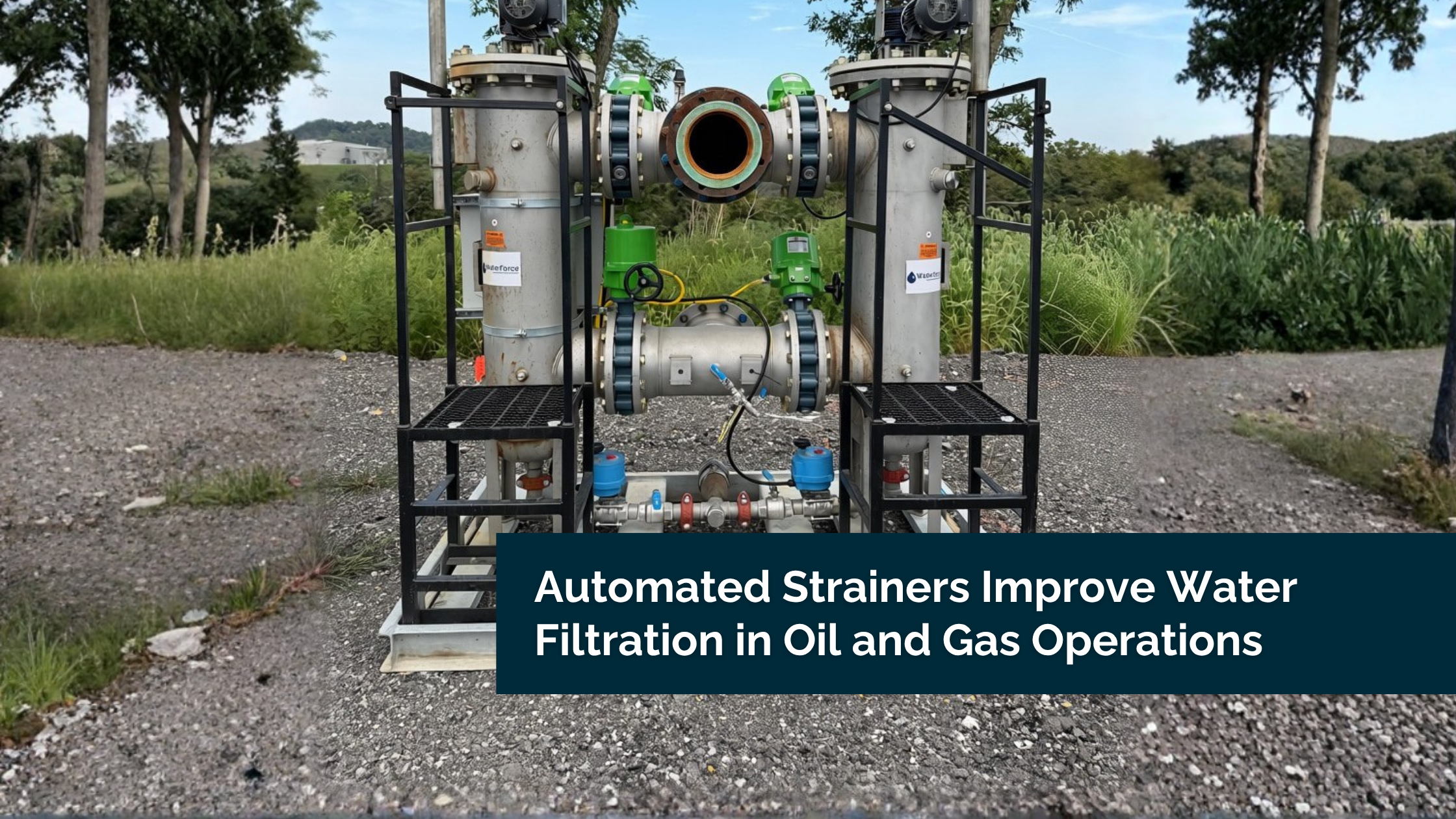
Keystone Clearwater Solutions automated filters allow water to flow through a reusable metal mesh that captures suspended material without significant filter buildup. The motor-driven mechanical brush removes accumulated solids from the mesh repeatedly, and directs them toward the bottom of the strainer. Therefore, it does not significantly impact the differential pressure within the system.
By continuously clearing solids from the mesh, the automated cleaning process restores usable filtration surface area and helps control solids-related pressure buildup without relying on repeated filter-sock changeouts.
How Can Automated Filtration Reduce Labor and Consumable Waste?
Filter-sock systems require operators to maintain an inventory of replacement media and assign personnel to inspect, remove, replace, handle, and dispose of spent filters. Moreover, higher solids loading shortens filter life and increases that labor requirement.
Keystone Clearwater Solutions automated strainers mechanically remove captured solids from the filtration surface and automatically discharges them instead of retaining the material inside disposable filter elements. As a result, operators can reduce or even eliminate the need to stock replacement filters, manually change filtration media, handle saturated filter socks, and dispose of spent filtration materials.
The system also reduces the number of maintenance interventions crews must perform to keep filtration operating. This is an especially important consideration at remote sites, temporary water-transfer operations, and large-scale projects where personnel must monitor and maintain multiple pieces of equipment.
Where Can Engineers Integrate Automated Strainers into Oil and Gas Water Systems?
Engineers can incorporate automated strainers at multiple points within an oil and gas water-management system based on water source, solids concentration, downstream equipment, and treatment objectives. Potential applications include source-water transfer, produced-water handling, recycled-water systems, water storage and transfer, pretreatment, temporary treatment systems, and water-conditioning processes.
Engineers can also position automated strainers upstream of pumps, meters, chemical-treatment systems, finer filtration, or other equipment where reducing suspended solids can improve operating conditions.
When specifying a filtration system, engineers should consider expected flow rate, solids concentration, particle-size distribution, required filtration level, allowable pressure loss, discharge requirements, and the characteristics of the downstream process.
Learn More About Keystone Clearwater Solutions Automated Strainers
Ultimately, automated strainer technology gives engineers designing water-transfer, produced-water, and reuse systems a practical way to control solids loading, protect downstream equipment, reduce maintenance requirements, and maintain more consistent operating conditions throughout the treatment train.
Contact Keystone Clearwater Solutions to discuss automated strainer applications for oil and gas water transfer, treatment, and reuse systems.